

Semiconductor innovation: from a technical problem to a partnership
Open innovation in semiconductors means working with external companies or research teams to solve a defined challenge in chip design, materials, manufacturing, packaging or testing. A useful partnership brief begins with the bottleneck and the evidence needed to show that a proposed solution works.
Which partnership model fits the work?
- Research collaboration: explore an unresolved technical question with an agreed experimental plan and access to the necessary facilities.
- Startup pilot: test a specific tool, material or process against the incumbent's requirements.
- Co-development: allocate engineering responsibilities and milestones for work that both partners must contribute to.
- Commercial qualification: establish the testing and acceptance process needed before a new supplier or technology can be adopted.
Define evidence before announcing success
Specify the test environment, comparison baseline, repeatability requirements and acceptance criteria. Keep simulation results, laboratory demonstrations, qualification and production use distinct. A faster design workflow does not automatically imply a faster manufacturing process.
Include access to data and equipment, responsibility for validation, the approval process and the next funding decision in the brief. Agree how the team will handle technical results that do not transfer to the intended operating environment.
See 2080's approach to corporate startup collaboration or discuss a semiconductor innovation challenge.
Continue with Semiconductor Partnerships: Open Innovation Cases to examine a related approach, then use 26 Best Machine Learning Startups Pitch Deck to compare the implementation questions.
Synopsis
Semiconductor innovation is at the heart of global technological progress, powering advancements in AI, 5G, and quantum computing. However, as demand surges, so do challenges related to sustainability, supply chain resilience, and cost efficiency. Open innovation provides a strategic pathway for corporates and governments to collaborate with startups, universities, and research institutions to drive breakthrough solutions.
Introduction
Did you know that the global semiconductor market is projected to reach $1 trillion by 2030 (McKinsey, 2023)? Yet, geopolitical tensions, chip shortages, and rising R&D costs pose significant risks. The key to overcoming these hurdles? Open innovation.
Corporations and governments are increasingly leveraging external collaborations to accelerate innovation, enhance sustainability, and secure competitive advantages. In this article, we explore how open innovation is reshaping the semiconductor industry, highlight recent success stories, and provide actionable insights for organizations looking to stay ahead.
1. Why Open Innovation Matters in Semiconductors
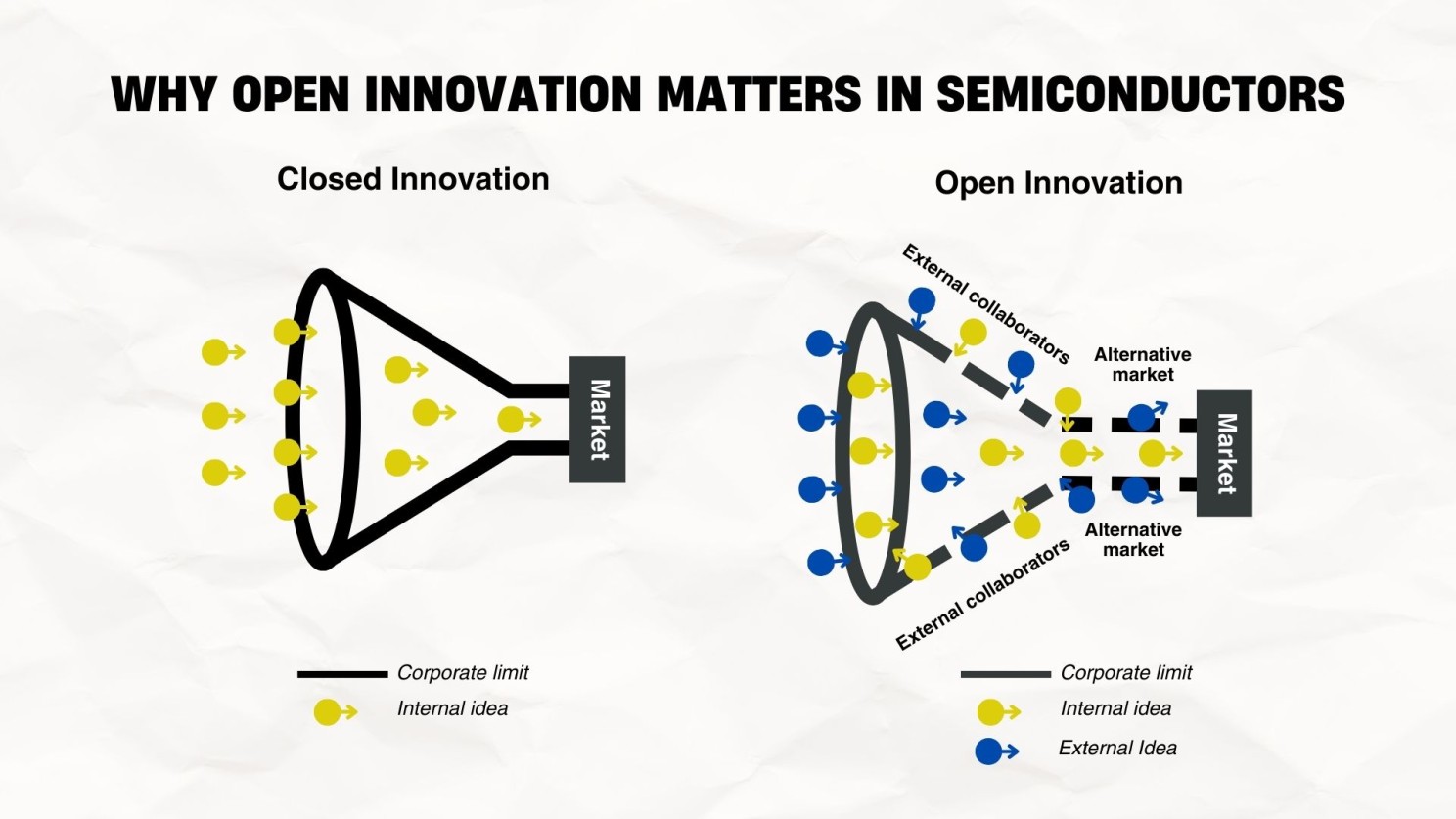
The Complexity of Semiconductor R&D
- Semiconductor development requires massive investments, with R&D expenses exceeding $80 billion in 2023 (IC Insights, 2023).
- Companies struggle to keep up with Moore’s Law, demanding exponential innovation cycles.
- Open innovation allows firms to tap into external expertise, reduce costs, and accelerate breakthroughs.
Key Drivers of Open Innovation Adoption
- Supply Chain Resilience: Companies like Intel and TSMC are partnering with startups to develop AI-driven supply chain forecasting models.
- Sustainability & ESG Compliance: Samsung collaborates with green-tech startups to improve energy efficiency in chip manufacturing.
- AI & Quantum Computing: IBM’s Q-Network engages startups to advance quantum computing applications in semiconductors.
2. Key Open Innovation Models in Semiconductors

Corporate Startup Collaborations
- Intel’s Ignite Accelerator connects deep-tech startups with chip manufacturing expertise.
- Qualcomm Ventures invests in AI and edge computing startups to drive next-gen semiconductor innovations.
University-Industry Partnerships
- TSMC collaborates with MIT and Stanford on 3D transistor research, reducing chip power consumption by 40%.
Government-Led Open Innovation Initiatives
- The EU Chips Act ($43 billion fund) fosters cross-border collaborations between governments, research institutes, and chip manufacturers.
- Japan’s Rapidus Consortium is a government-backed initiative to strengthen domestic semiconductor production.
3. Emerging Trends in Semiconductor Open Innovation
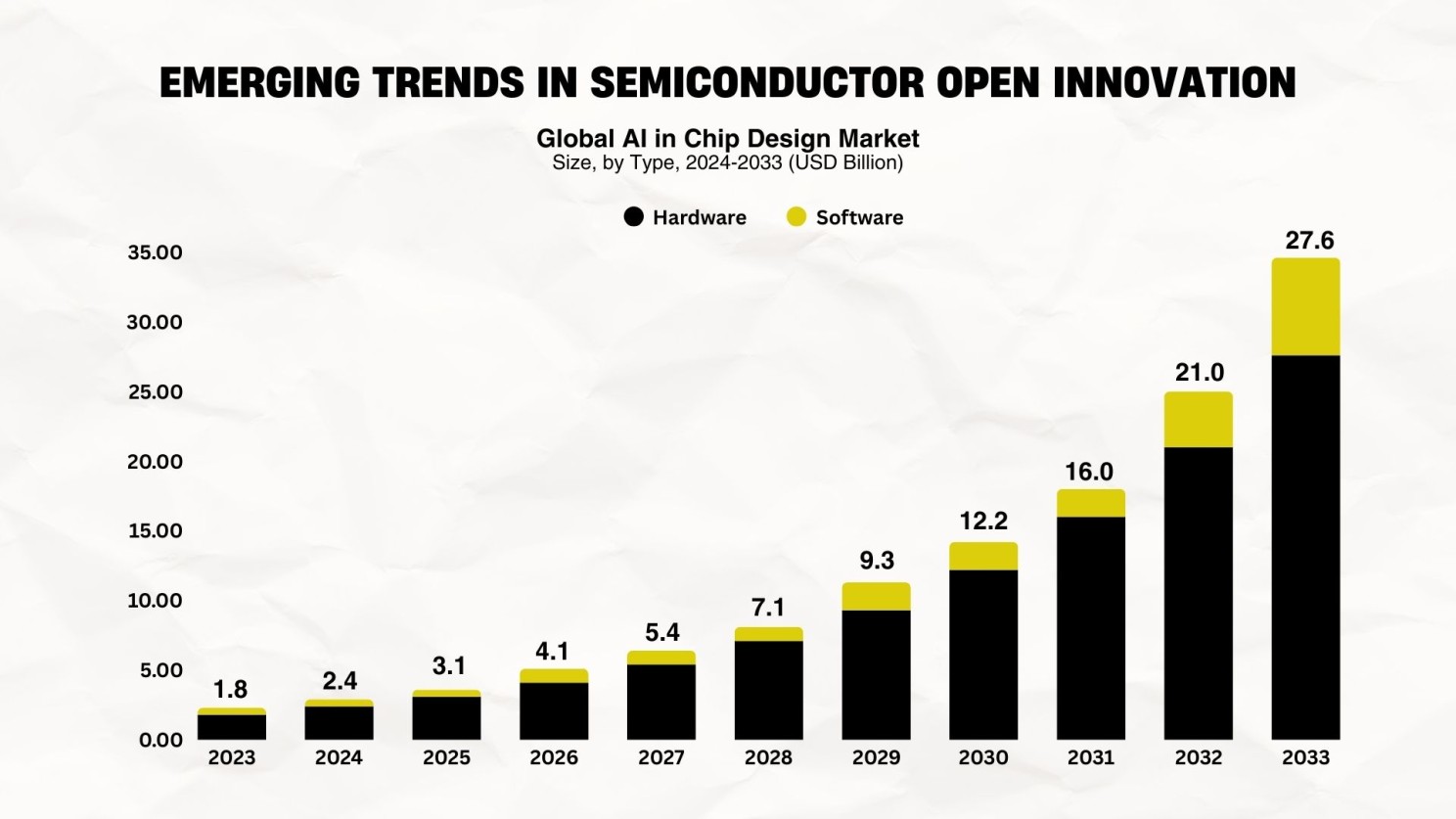
AI-Driven Chip Design
- NVIDIA’s collaboration with Synopsys speeds up AI-powered semiconductor design, reducing chip development time by 30%.
- Google’s Tensor Processing Unit (TPU) was developed using AI-optimized circuit layouts.
Sustainable Semiconductor Manufacturing
- IBM’s partnership with ASML focuses on EUV lithography, reducing energy consumption in chip fabrication.
- TSMC’s water recycling projects reclaim 90% of process water in semiconductor manufacturing.
4. Challenges in Implementing Open Innovation

Despite its benefits, open innovation comes with hurdles:
- IP Protection Risks: Sharing knowledge with external partners requires robust legal frameworks.
- Cultural Barriers: Corporations and startups operate at different speeds; aligning objectives is crucial.
- Regulatory Compliance: Cross-border collaborations must navigate geopolitical restrictions and data security laws.
✅ Solution Tip: Develop structured IP-sharing agreements, foster internal innovation champions, and engage legal advisors early.
5. How Corporates & Governments Can Leverage Open Innovation

Building an Open Innovation Roadmap
- Identify Key Innovation Areas – Focus on AI, sustainability, or supply chain resilience.
- Engage in Global Partnerships – Join government-funded programs or university-industry consortia.
- Leverage AI for Collaboration Matching – Automate startup scouting with AI-powered deal flow tools.
- Pilot & Scale – Start with pilot programs, measure KPIs, and scale successful partnerships.
Conclusion
The semiconductor industry is at a pivotal moment, with open innovation serving as a critical enabler of future growth. Corporations, startups, and governments must work together to unlock new efficiencies, ensure sustainability, and drive technological leadership.
FAQs
1. What is open innovation in semiconductors? Open innovation in semiconductors refers to the strategic collaboration between companies, startups, universities, and governments to accelerate technological advancements, reduce R&D costs, and enhance competitiveness.
2. How does open innovation improve sustainability in chip manufacturing? By collaborating with sustainability-focused startups, semiconductor firms can optimize energy usage, improve material efficiency, and develop eco-friendly manufacturing processes.
3. Which companies are leading in semiconductor open innovation? Companies like Intel, TSMC, Qualcomm, and NVIDIA actively engage in open innovation through partnerships, accelerators, and research collaborations.
4. How can my company start an open innovation initiative? Begin by identifying key challenges, scouting for potential partners, leveraging AI-driven matching tools, and piloting small-scale projects before scaling.
Further reading
OECD/Eurostat: Oslo Manual 2018 — A reference for innovation definitions and measurement; not verification of individual case-study outcomes.
Continue exploring
8 Best Manufacturing Startup Pitch Decks
Explore corporate innovation programmes or discuss your goals with our team.
Get more programme and corporate innovation insights
Join the 2080 Website Newsletter using the signup form below.





.svg)