How should a government choose an accelerator operator? Start with the change the programme must produce, then ask each bidder to demonstrate how its team, selection process, budget and follow-up support will deliver that change. Compare evidence from similar assignments rather than relying on the size of a global network.
This article proposes an evaluation framework for programme sponsors. The weights below are illustrative, not an industry benchmark or a claim about any operator's performance.
Define the assignment before comparing providers
A programme for researchers forming their first companies needs a different delivery model from one helping established startups win overseas customers. Write a one-page mandate specifying the target founder, starting stage, sector, location, intended outcome and measurement period. Include the constraints: staff availability, language, travel, access to customers and the sponsor's own responsibilities.
Then test whether an accelerator is the right intervention. If founders cannot reach buyers, more classroom sessions may not solve the problem. A customer-access programme or procurement pathway may be more appropriate. Nesta's accelerator research provides useful background on differences in programme design. For an introduction to the format, see how startup accelerator programmes work.

A proposed 100-point operator scorecard
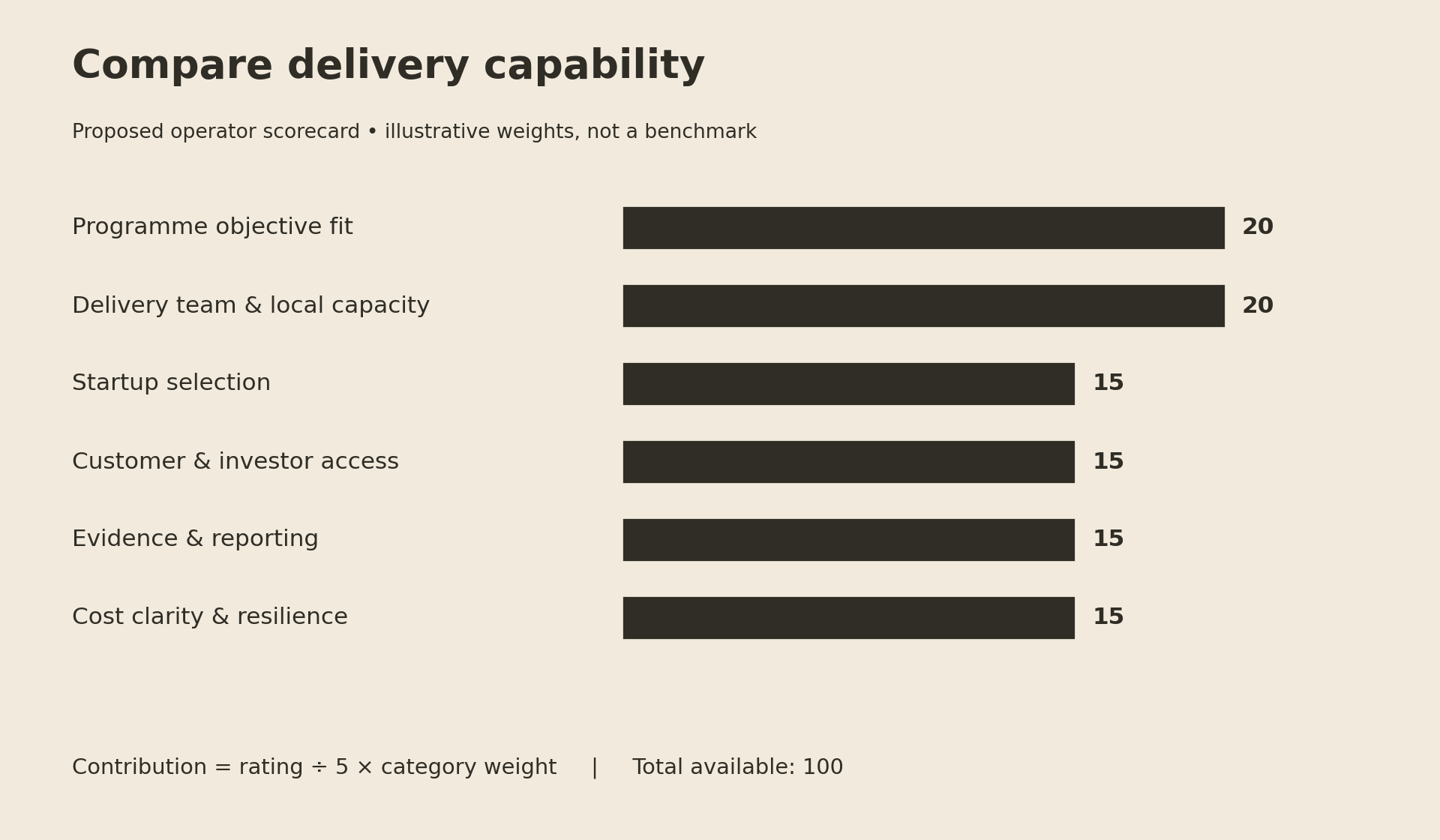
Give each category a rating from zero to five. Calculate its weighted contribution as the rating divided by five, multiplied by the category weight. Set the weights before reading proposals so they do not drift towards a preferred bidder.
- Fit with the programme objective: 20 points. Request an explanation of how the proposed activities address the founders' actual bottleneck, with assumptions and dependencies.
- Delivery team and local capacity: 20 points. Ask for named delivery roles, allocation of staff time, language coverage, local partners and arrangements if a key person leaves.
- Startup selection: 15 points. Review eligibility rules, sourcing channels, assessment criteria, reviewer calibration and handling of conflicts of interest.
- Customer and investor access: 15 points. Ask who will make introductions, how fit will be assessed and who will follow up. A contact list alone does not demonstrate access.
- Evidence and reporting: 15 points. Request an anonymised reporting example, metric definitions, follow-up process and referenceable assignments.
- Cost clarity and delivery resilience: 15 points. Examine the full scope, exclusions, subcontractors, travel assumptions, contingency and handover plan.
Keep mandatory requirements separate from scoring. A bidder that cannot meet an essential delivery condition should not compensate for it with a strong marketing presentation. The sponsor's procurement team should determine the applicable process and mandatory requirements.
Use a delivery exercise to test the proposal
Give shortlisted bidders the same fictional cohort brief. Ask them to describe the first month of work, an example founder intervention and a response to weak application quality. Keep the exercise bounded; it should reveal delivery judgement without demanding a complete unpaid programme design.
For example, suppose a bidder earns four out of five for local capacity. That contributes 16 of the available 20 points. The evaluator should record why: perhaps the team is named and available, but a specialist role remains unfilled. A score without its evidence is difficult to defend or learn from.
Request outcomes with their denominators
When a proposal says founders raised capital, ask how many companies were followed, how many responded, when the financing occurred and whether it was committed or received. When it reports partnerships, separate introductions, signed agreements, pilots and paid deployments. Do not attribute every subsequent company achievement to the accelerator.
Our discussion of open calls and targeted sourcing explains why intermediate steps need their own labels. For public-service programmes, also read evaluating GovTech evidence and outcomes.
Make the final comparison usable
Prepare a decision note showing the scores, supporting evidence, unresolved assumptions and conditions for mobilisation. Include the sponsor's obligations: access to stakeholders, timely decisions and a nominated programme owner. An excellent operator cannot independently remove every institutional constraint.
The resulting decision should answer a specific question: which team is best equipped to deliver this mandate, in this location, with this budget?
Discuss your programme brief
Explore 2080 Ventures' government programmes or share your target cohort, delivery market and intended outcomes. For more practical programme guidance, use the newsletter signup at the end of this page.
Sources and methodology
Nesta: A look inside accelerators. Background research on accelerator design; not validation of this proposed scorecard.