
One of the easiest mistakes in startups is to confuse being busy with making progress.
The two often look the same from the inside. Both fill your calendar. Both make you tired. Both give you things to talk about when someone asks how work is going.
The difference is that only one changes the company.
A founder can work twelve hours a day and still avoid the work that matters. They can go to events, meet investors, exercise, journal, optimize their schedule, redesign the pitch deck, join communities and answer messages until midnight.
Then you ask a simpler question: what changed?
Did you ship something? Did a customer buy? Did usage go up? Did you learn something that changed the product?
If not, you may have been busy without actually moving.
This is attractive because motion feels safer than judgment. Building exposes you to criticism. Selling exposes you to rejection. Planning another founder dinner does neither.
The busy founder is often losing
This sounds harsher than it is.
Exercise is good. Sleep is good. Reading is good. Talking to smart people is good. The mistake is not doing these things. The mistake is counting them as evidence that the company is working.
Some activities maintain the founder. Others build the company.
Confusing the two is dangerous because maintenance is often pleasant and building often is not. It is easier to improve your morning routine than your conversion rate. It is easier to add another meeting than to ask a customer why they will not pay.
A startup does not care how disciplined you feel. It only responds to what reaches the outside world.
This behavior is much older than startup culture
Long before coworking spaces, founder retreats and demo days, cities created social worlds where people could gather around an identity without necessarily producing the work associated with it.
In eighteenth century London, coffeehouses became important places for writers, publishers, merchants and political discussion. They were genuinely productive institutions. But they also attracted criticism for gossip, chatter and idleness. The Courtauld's history of Georgian coffeehouses notes that contemporary satirists attacked the conversation inside them as gabbling, gossiping and idle.
Nearby, Grub Street became shorthand for an ecosystem of aspiring authors, hacks, publishers and coffeehouses living at the edge of the literary economy. The point is not that everyone there was a fraud. Many people worked brutally hard. The point is that a recognizable social type had emerged: the person living inside the culture of writing more than inside the output of writing.
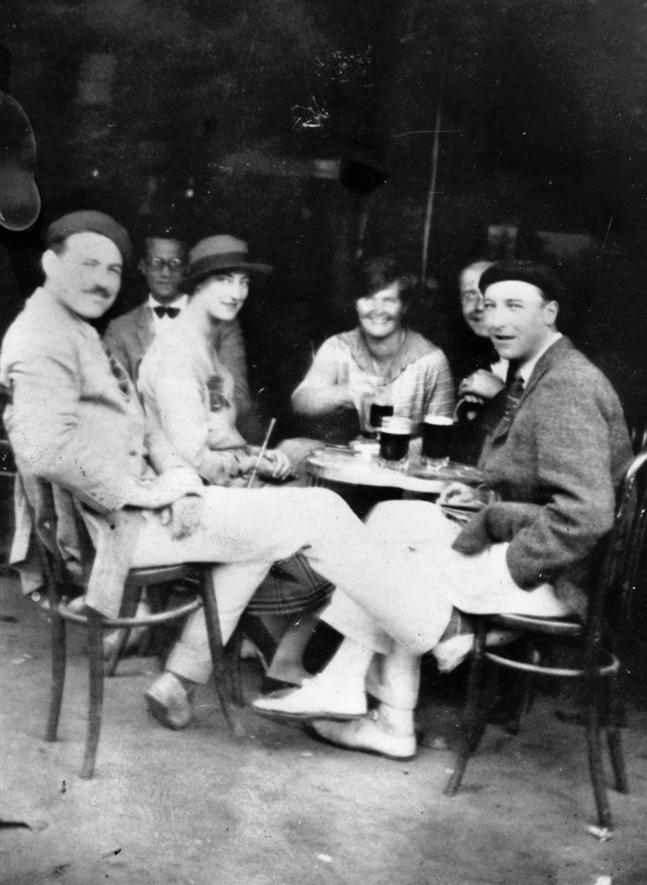

Orwell saw the founder cosplay problem in Paris
The episode you are remembering is in George Orwell's Down and Out in Paris and London. The details are even harsher than memory.
Orwell describes a Russian woman and her son living in the same cheap hotel. The mother worked sixteen hours a day darning socks. Her son called himself an artist, dressed decently and spent his time loafing in the Montparnasse cafés.
That image survives because the contrast is perfect. One person was doing unpleasant work that produced an economic result. The other possessed the appearance and social identity of a creative person.
Today, replace “artist” with “founder.” Replace Montparnasse with a coworking space in San Francisco, Dubai, Riyadh, Seoul or London. Replace the café conversation with a panel about AI, a founder WhatsApp group and a pitch night.
The costume changed. The psychological bargain did not.
Hollywood learned to sell the identity too
The early film industry created its own version of entrepreneurial aspiration. By the 1910s and 1920s, magazines and training businesses marketed “scenario writing” to ordinary people as a path into the movie business.
A 1923 advertisement in Photoplay promoted the story of “a housewife” who had learned to write photoplays and sold one. The advertisement promised large payments for acceptable scenarios and invited men and women to test whether they could become screenwriters from home.
There is nothing wrong with a housewife writing a screenplay. Some people genuinely broke into the industry. The interesting part is the business around the dream. Once an identity becomes aspirational, an ecosystem appears to sell the rituals, training, social proof and feeling of participation around that identity.
The startup world now does this at industrial scale.
The modern founder has infinite ways to avoid the market
You can spend an entire year “building a company” without enduring much contact with a customer.
You can attend startup events. You can join accelerators. You can refine your personal brand. You can redesign the pitch deck. You can build a Notion operating system. You can switch task managers. You can read twenty business books. You can schedule coffee with other founders. You can fly to conferences. You can apply to awards. You can optimize your morning routine. You can hire a coach. You can write a manifesto. You can work until 2 a.m.
Each activity has a respectable explanation. That is why the trap works.
Research on busyness helps explain the attraction. A 2017 study in the Journal of Consumer Research found that in the United States, being visibly busy and overworked can function as a status signal because observers infer competence, ambition and market demand from scarcity of time.
Founder culture makes this worse because busyness itself has become a status symbol. A full calendar can look like evidence that something important is happening.
Sometimes it is. Often it is just a full calendar.
A blank afternoon can make a founder nervous, because silence feels like inactivity. So they fill it. Coffee. Catch-up. Panel. Fireside chat. Quick sync. Community dinner. Investor breakfast.
By Friday they may have created the one thing a founder cannot afford: a week with no uninterrupted time to build.
The podcast test
I have an admittedly unfair heuristic: when an early-stage founder starts a podcast, I become suspicious.
There is nothing wrong with podcasts. A podcast can be distribution. It can produce leads, recruit employees, build trust, or create a useful media asset.
But timing matters.
If the product is unfinished, sales are weak, customers are confused, and the founder suddenly announces a podcast, the podcast may be doing psychological work rather than commercial work.
It lets you talk about the industry instead of selling into it.
You can invite impressive guests. You can publish clips. You can speak confidently about the future. You can acquire all the external signals of momentum without having to endure the awkward experience of asking someone to pay.
In that sense, a podcast can become entrepreneurship with flattering lighting.
The useful question is simple: does the podcast help the company?
If it produces customers, hires, partnerships or real distribution, keep recording. If it mostly produces clips of you explaining entrepreneurship while your own startup is not selling, the microphone may be a hiding place.
Networking is not selling
Networking is useful when it has a purpose. Meeting the right buyer can lead to a contract. Meeting a strong engineer can lead to a hire. Meeting an investor can lead to financing. Meeting a partner can open a channel.
But “I met a lot of people” is not a business metric.
A founder can attend three events a week for six months and come away with hundreds of contacts and no customers. The social environment can make avoidance easier because everyone around you is performing the same role. You spend time with other founders talking about fundraising, hiring, AI, markets and strategy. Nobody asks who paid you this week.
The group provides comfort. Everyone looks busy. Everyone validates everyone else's busyness.
Startup culture has a strange ability to let ten people with no customers sit around a table giving one another go-to-market advice.
The café is not the problem
This argument should not be confused with an attack on cafés, events, exercise or community.
Some of history's greatest writers actually wrote in cafés. Some of the best founders meet customers at conferences. Some people think better after exercise. Some partnerships begin over coffee.
The distinction is brutally simple: did the activity create an output or did it merely create the feeling of being the kind of person who creates outputs?
The table can be identical. The outcome is not.
Even startup orthodoxy warns founders about this
Y Combinator's published startup advice explicitly warns founders about conferences, dinners, investor meetings and other distractions. Its core recommendation for early stage companies is much simpler: launch, talk to users, build something people want and keep iterating.
Paul Graham made a related argument in his essay on the maker's schedule. Meetings may look harmless in a calendar, but for someone who must produce difficult creative work, a single meeting can fracture the large blocks of concentration required to make something.
That should terrify a founder whose week contains thirty meetings and no uninterrupted building time.
Use an output ledger, not a busyness ledger
You do not need another productivity system. You need a harder accounting system.
At the end of every week, ask four questions.
- What did we ship? A product, feature, prototype, experiment, proposal or deliverable that now exists outside our heads.
- What did we sell? A signed contract, paid pilot, purchase order, subscription, deposit or credible movement in a real sales process.
- What did we learn from users? Not from founders, mentors or social media. From people who use, buy or reject the product.
- What changed economically? Revenue collected, costs reduced, conversion improved, retention improved or a concrete asset created.
If the answer to all four is “nothing,” the week was probably not a productive week no matter how full the calendar looked.
Exercise is good. Treating exercise as company building is delusion
Founders should work out. They should sleep. They should have a life outside the company. A strong body and stable mind can increase the number of years you are capable of doing difficult work.
But those activities belong in the maintenance layer of life. They are not evidence that the startup is progressing.
The same is true of meditation, journaling, reading, cold plunges, supplements, morning routines and personal optimization. They can support the machine. They are not the machine's output.
The startup exists outside your body. Customers have to use it. Buyers have to pay for it. Employees have to build it. The market has to respond to it.
Stop performing entrepreneurship
The easiest way to waste a decade is to live close enough to entrepreneurship that you feel like an entrepreneur while remaining far enough from the market that the market never gets to judge you.
That is why events are comforting. That is why endless networking is comforting. That is why productivity rituals are comforting. They produce activity without rejection.
Selling creates rejection. Shipping creates criticism. Pricing creates objections. Asking for money creates clarity.
Those are features, not bugs.
A real company is built through repeated collisions with reality.
So keep the gym. Keep the journal. Go to dinner. Meet interesting people. Record the podcast too, if it actually helps.
But if the company has twelve podcast episodes, a polished founder brand, a beautiful Notion workspace, thirty conference badges and three paying customers, the market is giving you useful information.
Listen to it.
Build something. Put it in front of someone. Ask them to pay. Repeat.
None of this is new
None of this is an original idea.
People have been finding respectable ways to avoid difficult work for centuries. Writers did it in cafés. Aspiring screenwriters did it around Hollywood. Founders do it at conferences, coworking spaces and on social media.
The form changes. The temptation does not.
And perhaps that is why the point is worth repeating.
Some ideas are not valuable because they are new. They are valuable because they are easy to forget.
Sometimes repetition is what makes them stick.




.svg)