Did you know that prior to TerraUSD's collapse, Do Kwon quietly transferred 9 billion won (approximately $7 million) to a law firm, anticipating huge legal challenges ahead?

Do Kwon wasn't your typical crypto bro. This was a guy who'd worked at Apple and Microsoft, founded a mesh network startup called Anyfi (which had already raised $1 million), and possessed the kind of technical credentials that made VCs believe anything he'd say.
In January 2018, he co-founded Terraform Labs with Korean entrepreneur Daniel Shin, armed with a white paper that promised to revolutionize payments.
The goal was to create a systme that maintains a $1 peg, not through conventional system, but through sophisticated algorithms that would absorb volatility.
A disaster recipe: They were trying to create stability through instability, value through destruction, and trust through untested algorithms.
What They Promised vs. Reality:
🎯They promised: A decentralized, algorithmic stable currency that would revolutionize payments
❌They delivered: A yield-chasing scheme that attracted speculators, not real users
🎯They promised: Real-world adoption through partnerships like Chai (a Korean payments app)
❌They delivered: Fake transaction volume. Do Kwon later admitted to fabricating Chai's blockchain integration
🎯They promised: True decentralization through algorithmic mechanisms
❌They delivered: A system entirely dependent on Terraform Labs' subsidies and market manipulation
By 2019, Do Kwon had landed on Forbes' "30 Under 30" list. The company raised $32 million from crypto heavyweights including Binance, Arrington XRP Capital, and Polychain Capital.
Korean commerce giants like Ticketmonster and travel service Yanolja came aboard as partners. Everything was picture perfect
Did you know that Do Kwon's claims about Terra's decentralization were later exposed as complete fabrications?
3 Major Miscalculations by the Math Prodigy:
- Infinite demand for LUNA: The system only worked if people always wanted to own LUNA tokens
- Perfect arbitrage: It assumed rational actors would always step in to maintain the peg.
- Unlimited growth: The model required constant expansion to sustain itself
The final nails in the coffin:
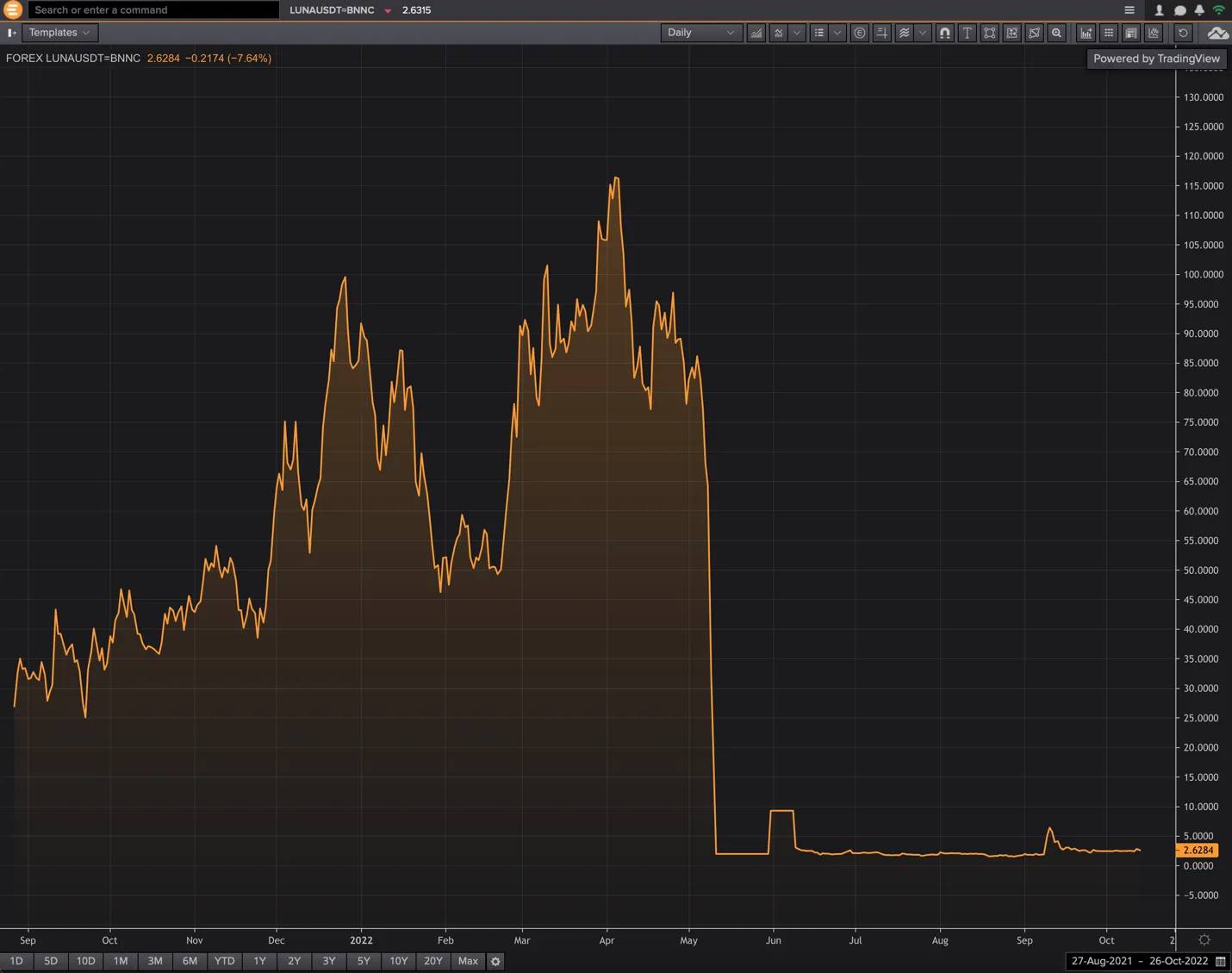
On May 7, Two large addresses withdrew 375 million UST from Anchor Protocol. Bot monitoring services detected an 85 million UST swap for USDC.
UST's price dropped to $0.985,
While UST was experiencing its death spiral, traditional fiat-backed stablecoins like USDC and USDT barely flinched. Why?
Because they were backed by actual reserves, not algorithmic fluff.
Terra wasn't just a two-token system, it was supposed to be an entire blockchain ecosystem hosting thousands of decentralized applications.
When Terra collapsed:
- $28 billion in value was wiped from Terra-based dApps
- Entire projects built on Terra became worthless overnight
- Developer talent fled to other blockchains
- The "Terra 2.0" relaunch was met with universal derision
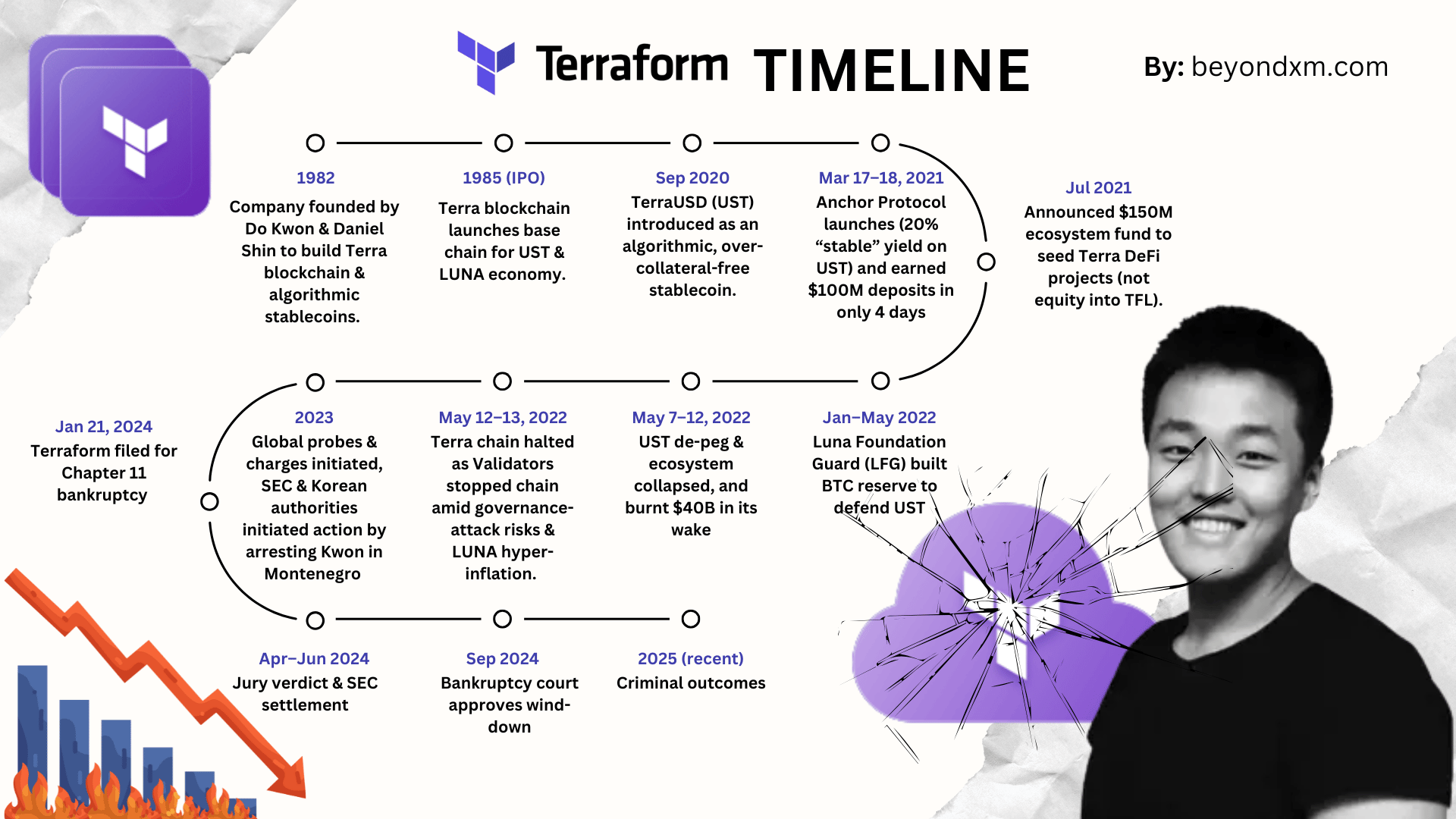
Terra's collapse triggered a cascade of failures throughout crypto, contributing to the bankruptcies of Three Arrows Capital, Celsius Network, and dozens of other firms.
It wasn't just a single company failure; it was a systemic event that proved how interconnected and fragile the crypto ecosystem had become.
5 lessons to learn from Terraform's $41 Billion Mistake
- Avoid Valuation Bubble: Terra tried to create value from thin air through algorithmic mechanisms, but algorithms can't suspend the laws of economics.
Lesson: Real businesses solve real problems for real people, they don't just move money around in circles.
- Sustainable Growth: Anchor Protocol's 20% yields were entirely subsidized by Terraform Labs, burning through $6 million daily by April 2022. This created artificial demand that disappeared the moment the subsidies became unsustainable.
Lesson: If your business model requires permanent subsidies to function, you don't have a business model.
- Agility>Arrogance: Do Kwon's Twitter feed was a masterclass in hubris. He mocked competitors, dismissed critics, and publicly stated there was "entertainment in watching companies die."
Lesson: Arrogant founders create blind spots that become fatal flaws.
- Market Fundamentals: When the SEC issued subpoenas, Kwon's response was to threaten legal action rather than engage constructively. This adversarial approach turned regulators from potential partners into active opponents.
Lesson: Smart founders work within frameworks, not against them.
- Timing>Vision:Terra launched during the greatest bull market in crypto history, with unprecedented liquidity and risk appetite, but even perfect timing couldn't save a fundamentally flawed model when conditions changed.
Lesson: If your company only works during perfect conditions, it will fail when conditions inevitably change.